



Years after her first voyage there, Dunia Baru is going back to Palau, this time as the first traditional Indonesian phinisi licensed to charter in its waters.
Palau lies across the open Pacific to the north and east of Raja Ampat, a scatter of limestone islands at the western edge of Micronesia. It is one of the great diving destinations on earth, and almost no one arrives there on a wooden sailing ship.
Dunia Baru has done it before. In 2018, under her previous owner, she made the crossing and spent a month on charter in Palau. Her current owners have talked about taking her back for years.
From December 2026, she returns. She will be the first traditional Indonesian phinisi licensed to charter commercially in Palau, on a seven-day itinerary through the Rock Islands, Jellyfish Lake and the Second World War dive sites of Peleliu.
The Boat
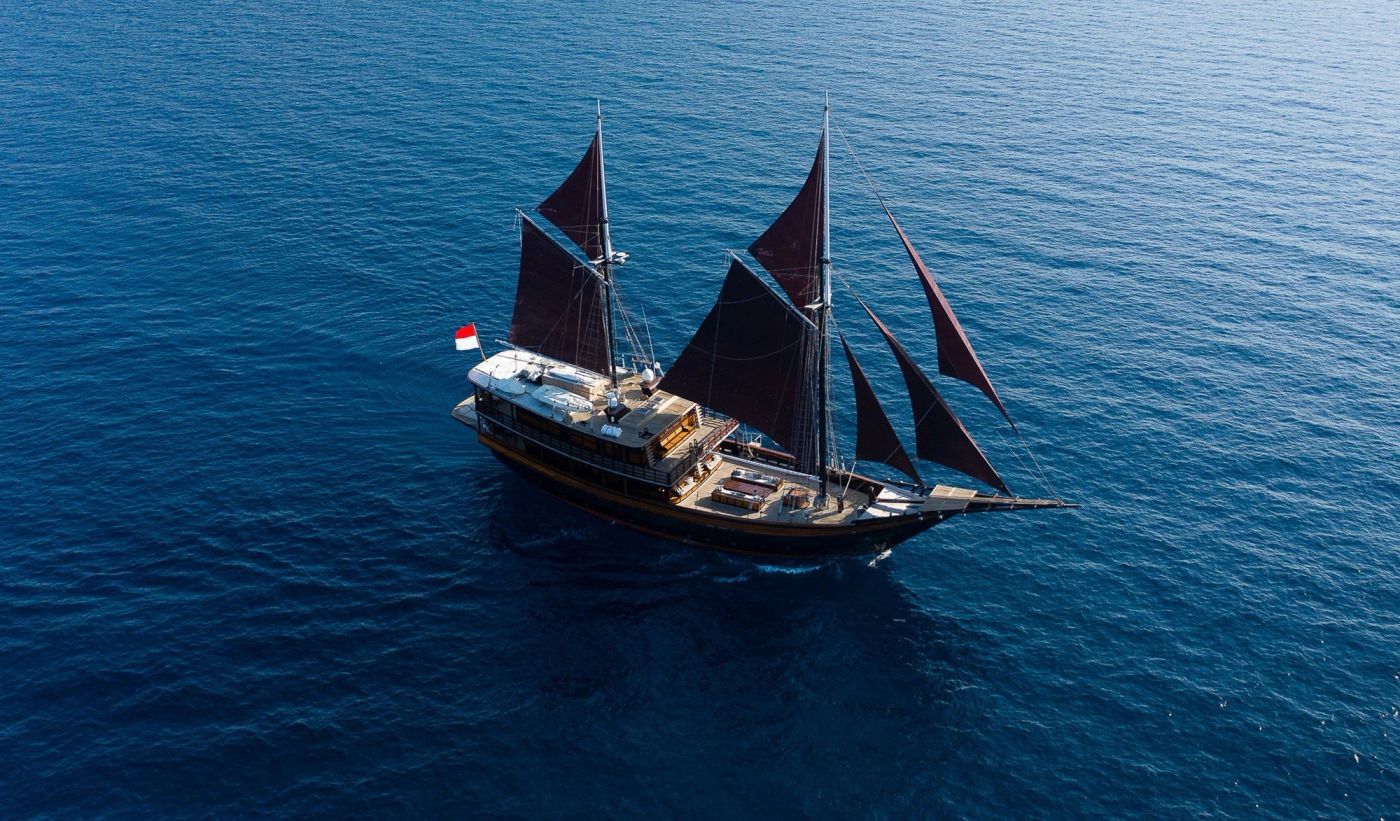
Dunia Baru was built by hand by the Konjo boatbuilders of South Sulawesi and launched in 2014. She is fifty-one meters of ironwood and teak, built to lines by Karsten Marine. At 395 gross tons she is a large ship for a phinisi, and she was built for range. Her owners give it as 6,800 nautical miles, enough for the long Pacific crossings few wooden yachts attempt.
She carries fourteen guests in seven cabins, including a master suite aft with its own deck. She has eighteen crew, among them men who built her, and her open galley runs the length of the main deck around a teppanyaki grill. Her dive center carries a PADI instructor and Nitrox, thirty-four underwater lights for night dives, four tenders and two jet skis, and she sails on new generators, rigging and sails since her refit. She was built for exactly this. Her restoration has its own story in Dunia Baru Reborn.

Dunia Baru under sail on open water.
Palau
Palau is a small country with an outsized record of looking after its ocean. It created the world's first national shark sanctuary in 2009. In 2015 it set aside about eighty percent of its waters as the Palau National Marine Sanctuary, closed to commercial fishing and extraction, an area larger than the state of California. And every visitor signs the Palau Pledge on arrival: a promise, stamped in the passport, to act responsibly toward the islands and the sea.
At the center of it all is the Rock Islands Southern Lagoon, listed as a UNESCO World Heritage Site in 2012. It holds hundreds of uninhabited limestone islands, undercut by the sea into green mushroom shapes, ringed by white sand and reef, and accessible only by boat.
The lagoon holds more than fifty marine lakes, cut off from the open ocean for thousands of years. The most famous is Ongeim'l Tketau, Jellyfish Lake, on the island of Eil Malk. Its golden jellyfish evolved in isolation until their sting became almost imperceptible, and each day they migrate across the lake following the sun.

The Rock Islands of Palau from the air.
Their numbers rise and fall with the weather, from tens of millions at the peak to only a few thousand in hard years. The lake closed from 2016 to 2018 to let them recover. In 2025 their numbers fell sharply again, and the lake stayed open. A swim there today may mean scattered jellyfish instead of the famous swarms. Even so, few places on earth feel as strange and still.
Beyond the lagoon lie some of the most famous dives in the Pacific: Blue Corner, with its walls and current, and German Channel, with its manta cleaning stations. To the south, the island of Peleliu was the scene of one of the hardest-fought battles of the Pacific War in 1944. It still holds wrecks, aircraft and relics, underwater and in the jungle.

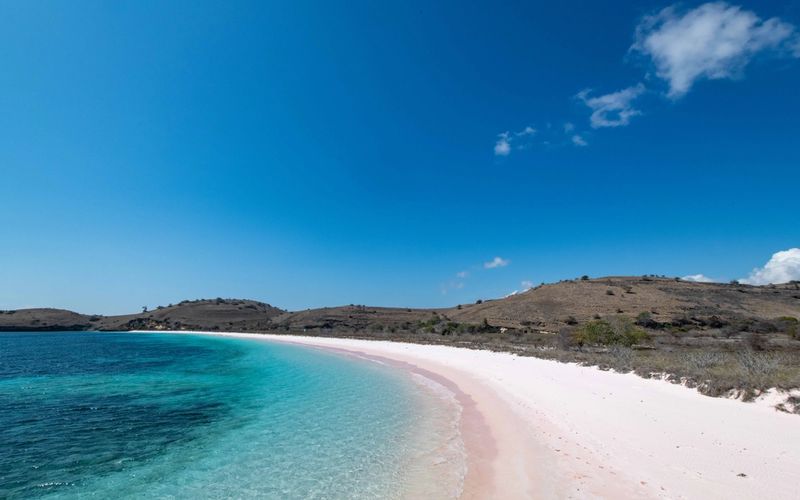
A quiet beach in Palau's Rock Islands.

Divers descend through Palau's Blue Holes.
Why a Yacht
Most visitors to Palau stay in Koror and take day boats into the lagoon, sharing the famous sites with everyone else at the same hours. A yacht changes that.
Dunia Baru anchors in the Rock Islands themselves, so guests can be in the water at first light and at dusk, when the day boats have gone home. Her four tenders reach the outer reefs and channels quickly. And the evenings belong to the ship: dinner on deck in a lagoon with no other lights.
When to Go
Palau's driest months run from about December to April, which brings the clearest diving and the mantas of German Channel. Dunia Baru's Palau season is built around this window. Guests fly into Koror, usually connecting through Guam, Manila, Taipei, Seoul or Tokyo.
Coming Home to a Far Place
Dunia Baru's name means New World. It suits a ship that keeps going further than her type was ever built to go. For guests who have already seen Komodo and Raja Ampat, Palau is the next horizon, and there is now a phinisi to take you there. Her first voyage there is told in Voyage of The New World.
Her Palau season opens in December 2026 and runs through the driest months of the Pacific year. Her yacht page has the cabins, the seasons and the itinerary, and we will tell you plainly what is still open.
Continue Exploring
Dispatches from the far corners of the archipelago. Yacht features, expedition reports, and the stories behind our most memorable charters.
Practical Guides
Everything you need to know before chartering in Indonesia. From costs and logistics to destination comparisons and packing lists.
Inspired to explore?
Our team has sailed these waters for over a decade.Let us help you plan your own Indonesian adventure.