



Michelin does not inspect yachts. Her owners' resort holds One Michelin Key, so we held Vela against the inspectors' five criteria, one at a time.
In 2024 the Michelin Guide did something it had never done in a century of stars. It created a distinction for hotels, the Key, judged by anonymous inspectors against five fixed criteria. The first Keys went to France that April. In October 2025 the selection went global, and inspectors chose 2,457 hotels from the more than 7,000 in the Guide.
One of them sits above a waterfall in Tabanan, Bali. Nirjhara, a resort of 25 villas whose name is Sanskrit for flowing water, received One Michelin Key when the Keys reached Indonesia, then kept it in the 2026 selection released this September. Michelin's entry describes villas that nod to traditional Balinese architecture, rooftop bathtubs open to the sky, and an infinity pool looking over the waterfall.
Vela belongs to the same two people. Dimitri Tran and Adrien Portier, the hoteliers behind Nirjhara, built her after two family charters in Komodo and Raja Ampat left them convinced that the standard they kept on land had not yet made it to sea. We interviewed them about that crossing recently. This piece asks a narrower question. Michelin does not inspect yachts, so we held Vela up to the five criteria its inspectors use, in Michelin's own wording, one criterion at a time.
Excellence in Architecture and Interior Design
Start with the lines. Vela was drawn by Tresno Seery, the Java-born, American-educated naval architect whose mother, Patti Seery, launched Silolona in 2004 and with her set the pattern for the luxury phinisi. He spent a year living in Sulawesi through the build of her second ship, Si Datu Bua, before he ever drew his own. “We held a lot of respect for Tresno from the beginning,” Tran told Robb Report.
His drawings then met a tradition that has never used any. Vela was raised on the beach in South Sulawesi by the Konjo boatbuilders of Bulukumba, whose craft UNESCO listed as Intangible Cultural Heritage in 2017, and who work in the reverse of Western practice. The planks of the hull are shaped and fastened first, the frames fitted after, and the proportions are carried in the master builder's head. Tran still marvels that the builders raise the skin with no ribs to guide them and port comes out matching starboard exactly. Launching her, in 2022, meant easing fifty metres of ironwood into the sea by hand, with chains, over a month.

Her name over her port. Bulukumba, carved at the stern.
The result reads like a thesis on seakeeping. She is 50 metres overall yet carries just 9.75 of beam, a long, narrow hull with a double keel that keeps her weight below the waterline, and her draft of 3.8 metres, deep for the type, was specified for composure on open crossings. Robb Report calls the shape hydrodynamic, efficient and stable. The masts are carbon, the rig among the tallest carried by any phinisi, flying nearly 7,000 square feet of off-white sail, and the main boom, rare on the type, doubles as a crane for the tenders and toys. The owners wanted sails that are more than decoration, and she makes six knots under canvas alone. In honesty, the 890 horsepower engine still takes most crossings, to shorten them and buy more hours at anchor.

At the gaff, making sail.
Below deck, the deliberate choice is volume. She carries six cabins where the hull could take more, because high ceilings, wide corridors and tall windows are decided once, on the beach, and can never be added later. The Owner's Suite runs to 40 square metres with a private terrace, the Master Cabin to 35, the four staterooms from 18 to 23, and every one of them carries marble vanities and Axor fittings by Philippe Starck. The owners claim she is among the most spacious phinisi in Indonesia. Twelve guests in fifty metres is the arithmetic behind the claim.

The Owner's Suite. Volume is decided once, on the beach.
The interiors are by Natacha Tanguy, the Parisian designer whose brief was that traditionally built must not mean rustic, and they run light where most phinisi run dark. What fills them is the point. Custom ceramics handmade in Ubud by Gaya Ceramics. Natural-dye kimonos handwoven in Bali by Tarum. Teak furniture made locally by Warisan from sustainably sourced wood, and fifteen works of contemporary art chosen with three of Indonesia's leading galleries, Gajah Gallery, Tony Raka and ISA. The European pieces earn their places without setting the tone, with fabrics by Hermès, Dedar Milano and Rubelli, and marble beside handmade Ubud terracotta in the bathrooms. Her own site puts the philosophy well: a phinisi furnished entirely from Milan would be a costume, and one furnished entirely from Ubud would be a theme.

Twin marble vanities and a full bathtub, at sea.
Quality and Consistency of Service
Eighteen crew sail her for twelve guests, and the owners filled the roster the way hoteliers do, from hotels. The head steward spent 27 years at Amanwana. The dive instructor spent 25 with Aman properties, and the galley team trained at Nirjhara itself. The spa menu was created for Vela by The Retreat at Nirjhara, using natural products from the archipelago, and treatments are given on deck, in the cabin or on a beach. A cruise director and an activities manager sit with guests and rework each day as it comes. The crew are the heart of our interview with the owners, so we will not retell their stories here.

A treatment from the menu written by The Retreat at Nirjhara.
Consistency is the harder half of this criterion, and Michelin treats it that way. A Key is not a trophy. Inspectors return anonymously, and a Key can be withdrawn. A yacht faces the same test every season with no inspector but her guests, and her evidence is the kind hoteliers trust: repeat bookings from her second season on, and menus built each morning from whatever the markets and the fishermen bring.

Spiny lobster, from the fishermen she anchors beside.
Overall Personality and Character
Robb Report spent a week aboard her around Komodo and landed on the phrase “a sea wolf in sheep's clothing.” From the water she reads as an early spice-route schooner, dark ironwood, gaff rig, pale canvas. Everything else aboard is a quiet surprise, down to the frosted glass and the Nitrox dive centre. Even the name looks two ways at once. Vela is a southern constellation, Latin for the sails, and a Sanskrit word for shoreline.
Character shows at night. The crew will make up a full bed on the aft-deck daybed, and guests fall asleep under the Milky Way. AFAR's writer slept out there and observed that no hotel on Earth offers the experience, then spent a dawn hour and a half swimming with whale sharks in Saleh Bay, asking herself, “Is this real life?”

The aft daybed, made up for a night under the stars.
Value for the Price
Michelin's fourth measure is the plainest, so here it is plainly. Vela's rate carries the full crew and fuel, every meal and snack, water, juices, coffee and soft drinks, diving for certified divers with Nitrox aboard, every land and sea excursion, the jet skis and SeaBobs wherever park rules allow them, airport transfers, up to four hours of spa treatments a day, unlimited Starlink, the national park fees and the laundry. Alcohol, crew gratuity, PADI courses, dive insurance and flights sit outside it. Minimums run four nights in Komodo and six in Raja Ampat, Alor, Maumere and the Spice Islands. The rates themselves live on her yacht page, beside her seasons, which is where numbers belong.
A Significant Contribution to the Neighborhood or Setting
Michelin's fifth criterion asks what a hotel gives the place around it. Vela floats, so the question widens to an archipelago. Her hull is ulin, Borneo ironwood, and the owners had twice as many trees planted as the build consumed, in the same part of Borneo that supplied the timber. Their site goes further and notes that ulin is listed as a Vulnerable species, inviting the debate instead of hiding it, and that candor is itself a standard. The furniture teak came from sustainable forestry. Single-use plastic is banned from the cabins, the amenities are reef-safe and made in Bali, drinking water is made aboard from the sea, and the air conditioning cools with seawater, no freon, no humming units on the top deck.
The rest of the contribution is human. Commissions to the galleries and makers above. A yard in Bulukumba that keeps a UNESCO-listed craft in paid work. Two crew from Moyo Island who walk guests into corners of their island no visiting boat would find, and whale shark mornings in Saleh Bay arranged with generous payment to the bagan fishermen whose platforms draw the animals. A wooden ship asks more upkeep than steel, and needs a yard that still knows how to give it. The owners call that a fair trade.

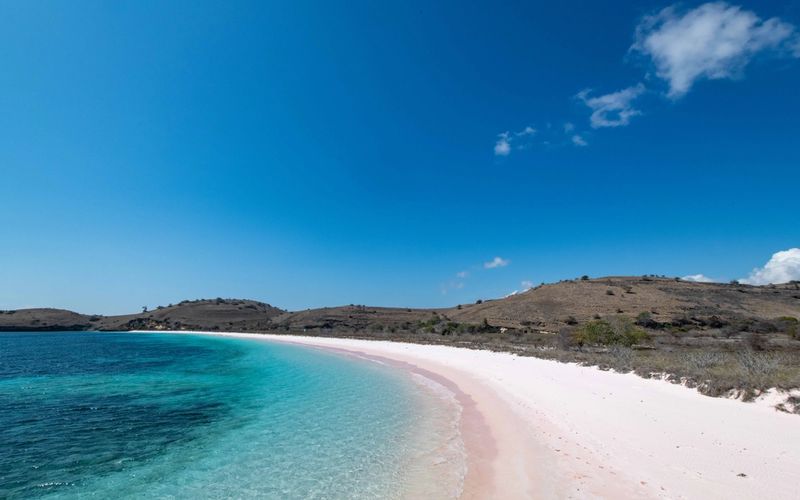
The neighborhood.
The Standard, Not the Key
Vela holds no Michelin Key. She cannot, because Michelin does not rate yachts, and we will not pretend otherwise on her behalf. What she holds is harder to print on a plaque. The two hoteliers who earned a Key at Nirjhara, and kept it when the inspectors returned, run their ship to the same five measures, with the same spa hands, the same conviction that detail is the whole job. The standard was earned on land. It sails under an Indonesian flag.

Under way, in home waters.
The owners tell their side in our interview, Sailing Yacht Vela's Approach to Hospitality.
Vela is available for private charter through Indo Yachts. Her yacht page has her suites, seasons and itineraries.
Continue Exploring
Dispatches from the far corners of the archipelago. Yacht features, expedition reports, and the stories behind our most memorable charters.
Practical Guides
Everything you need to know before chartering in Indonesia. From costs and logistics to destination comparisons and packing lists.
Inspired to explore?
Our team has sailed these waters for over a decade.Let us help you plan your own Indonesian adventure.